
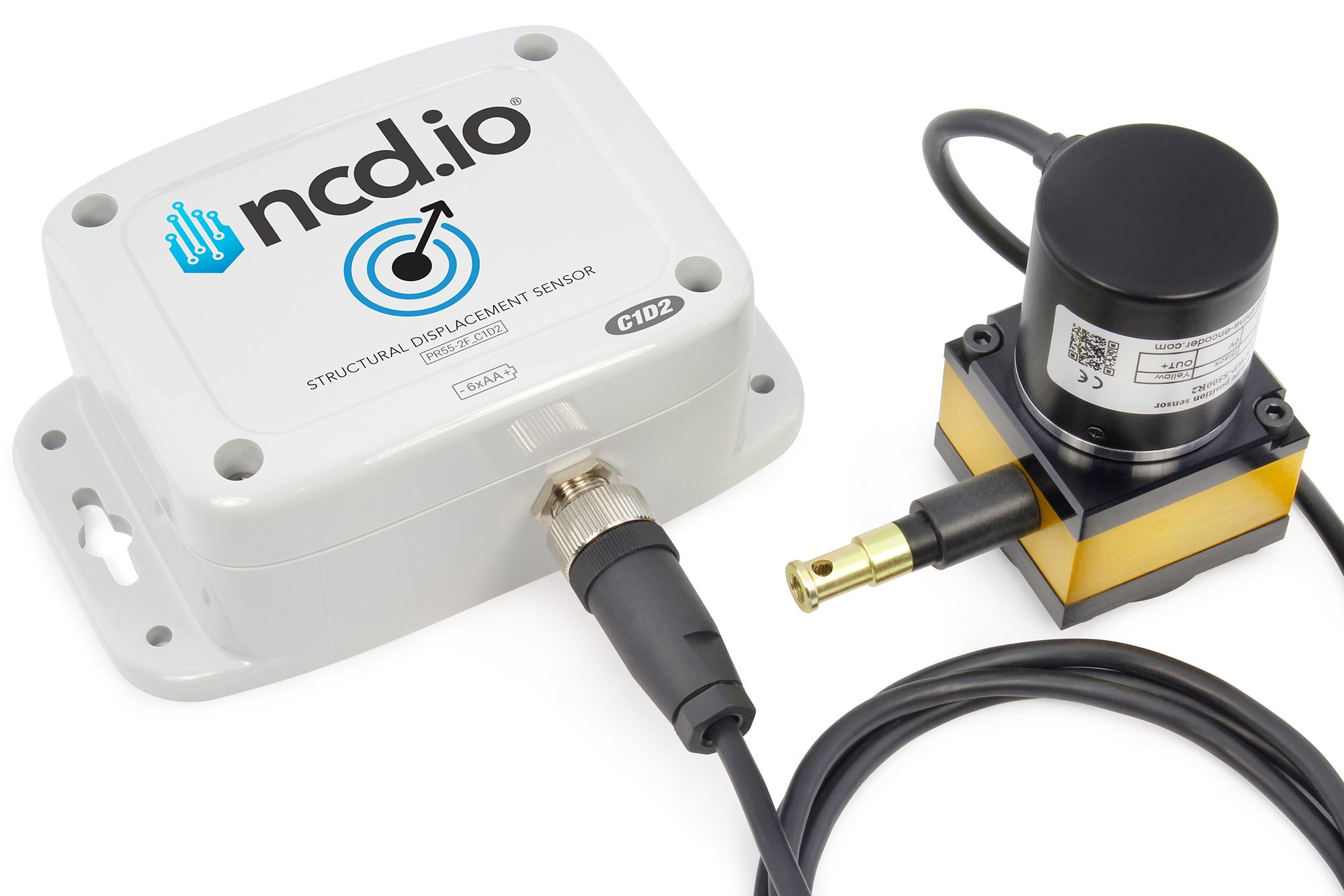

Wire Draw Sensor for Industrial IoT Structural Monitoring
Presenting the NCD Long Range IoT Wireless Structural Monitoring Sensor, designed for a 2 Mile wireless range with mesh networking capabilities. Primarily utilized for monitoring structural displacements, it detects movements and shifts at various structural points. Ideal for installation between footings and walls or alongside steel supports, this sensor reports any alterations in distance due to its spring-loaded cable mechanism. It is perfect for applications such as positional control, beam testing, hydraulic movement detection, and structural shift monitoring. The sensor is secured with two screws, plus an additional screw for the retractable cable, which provides analog position feedback during length changes.
Featuring a single-channel 10-bit ADC, the sensor periodically samples and wirelessly transmits data, entering a low-power sleep mode between transmissions to extend battery life. It can detect positional changes every 7 seconds (configurable), updating the cable length data if displacement varies by more than 10% (configurable). This energy-efficient operation, combined with a broad application spectrum, ensures its versatility. The sensor outputs an analog value from 0 to 1023, indicating full extension or retraction of the displacement cable. With four AA batteries, it supports up to 500,000 transmissions, offering up to a decade of service, depending on use and conditions.
Sensor Details
The sensor uses a 50cm retractable wire cable, actively pulling to retract, and provides readings from 0 to 1023 as the cable extends. It should be mounted to track movements between two points, detecting linear shifts without assessing angular changes. Optimal functionality is achieved with the cable partially extended, allowing for precise detection of any length variation. However, it does not measure angular shifts, focusing solely on linear movements.
The Long Range IoT Wireless Structural Monitoring Sensor stands out for its extensive range, affordability, precision, longevity, and robustness, meeting and surpassing the needs of both industrial and consumer sectors.
Transmission Interval
This device sends data periodically, based on user-preset timing intervals.
This device sends data when sensor readings exceed preset limits.
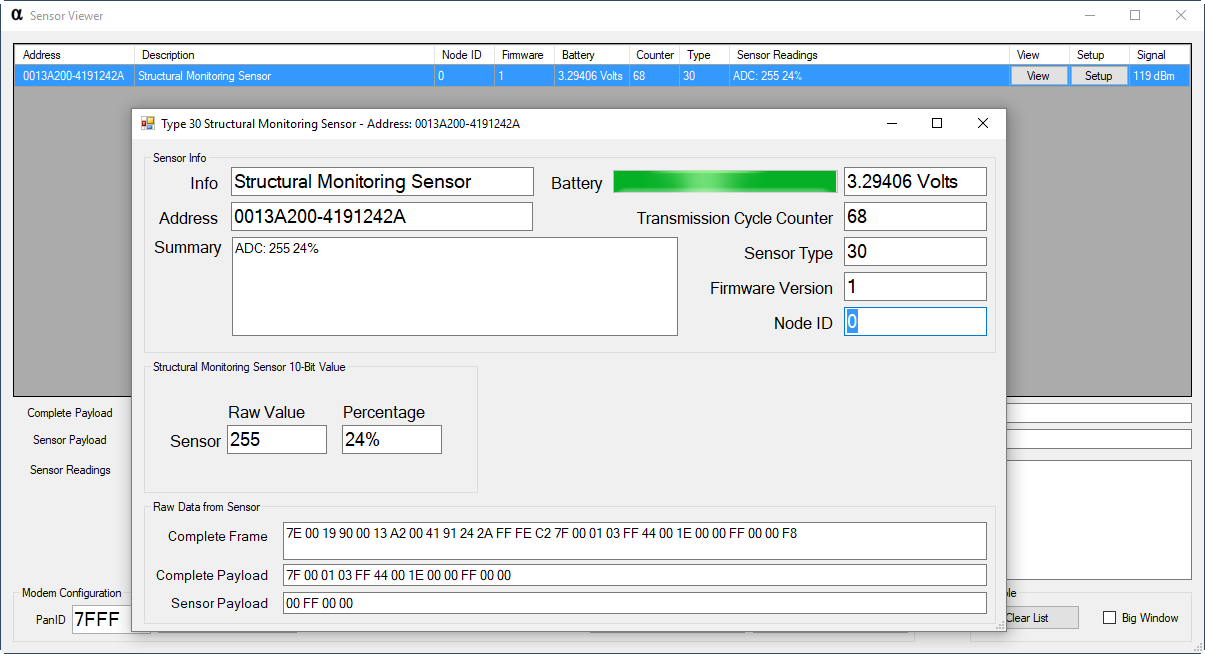
Wireless Structural Monitoring Sensor Applications
- Structural Health Monitoring
- Steel Beam Displacement Monitoring
- Lifting and Spreader Beam Testing
- Hydraulic Movement Detection
- Linear Displacement Detection and Measurement
- Structural Crack and Shift Monitoring
- Push Structural Monitoring Data to Cloud Services:
- Amazon AWS, Microsoft Azure, Temboo, Losant, MQTT
- Push Structural Monitoring Data to Computers:
- Ethernet, WiFi, Bluetooth, RS-485, RS-232, and USB
Mechanical Drawing

Wiring Diagrams
